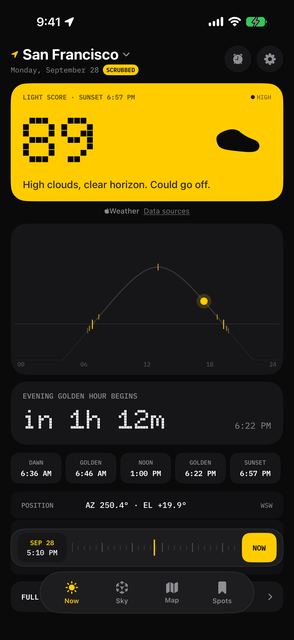
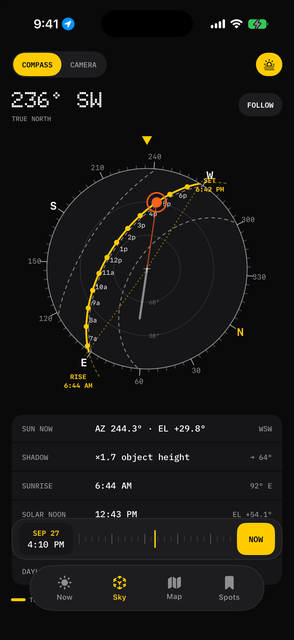
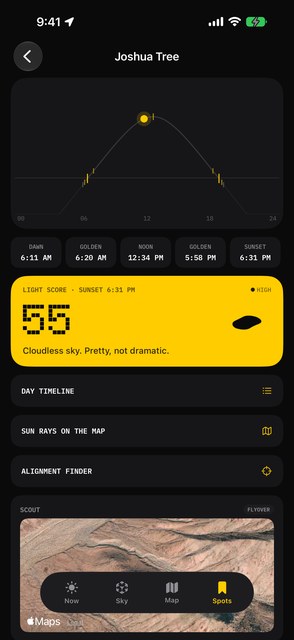
Every sunrise and sunset scored 0–100, hours ahead, from the cloud layers at your horizon. The sun's path in AR. Real building shadows. One dial that drags the sun through time — computed entirely on your iPhone.
The insight: whether a sunset is gray mush or fire is decided by cloud geometry at the horizon — and that geometry is already in the forecast. High clouds at partial coverage are a canvas for color; a low deck walls it off.
SunDeck reads the layer-by-layer forecast at the event hour, runs it through an on-device model, and answers the only question that matters: is tonight worth the drive? With the reason in plain words and a confidence dot — never a bare number.
0–100 · 10-day horizon · stale forecasts flagged · model versioned
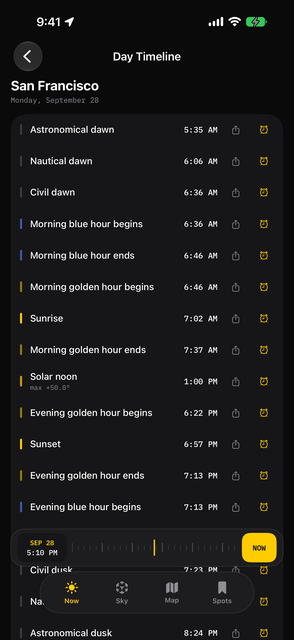
One scrubber on every screen. Haptic detents land exactly on sunrise, sunset, and the twilight edges. Any date, 1900–2100, any place on earth.
An AR arc with hour markers, rise/set pinned to your horizon, and solstice ghost paths. Camera off? A fully functional virtual sky takes over.
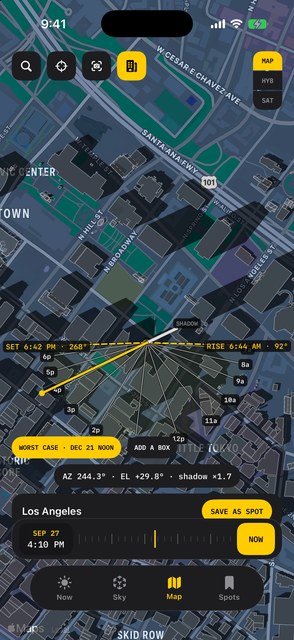
OpenStreetMap footprints, extruded and projected for any date and hour. A Worst Case button jumps straight to winter-solstice noon. Honest hatching where heights are estimated.
"20 minutes before golden hour" stays right as seasons shift — through time zones, travel, and DST. True alarm-style alerts can break through Silent.
The arc on your Home Screen, Lock Screen, and StandBy. A Live Activity counts golden hour down in the Dynamic Island. Most days you never open the app.
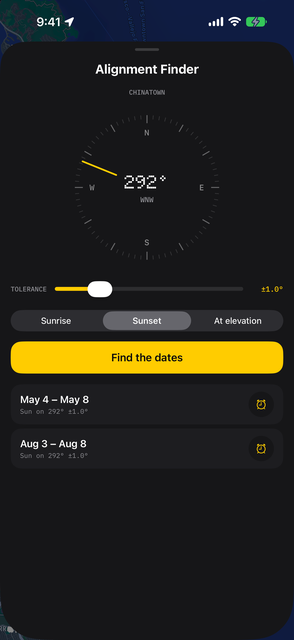
Aim a bearing at the arch, the bridge, the street canyon — get the exact date windows the sun rises or sets on it, with a one-tap alarm.
Solar geometry never touches a network — it's computed by an on-device engine tested against the U.S. Naval Observatory to the minute. Your location never leaves your iPhone. No account, no analytics, no ads. Forecasts come from Apple Weather; your Spots sync through your own iCloud. That's the entire story.
Positions are within ±0.1° and event times within ±1 minute of NOAA/USNO reference data — verified by a golden test suite covering 13 cities from Singapore to Longyearbyen, DST transitions, leap days, and polar seasons, pinned to the U.S. Naval Observatory and JPL Horizons.
Sometimes — it's a forecast. That's why every score ships with its reason and a confidence dot, why stale forecasts are flagged, and why the model is versioned so tuning is traceable. When data is sparse, SunDeck says "low confidence" instead of being confidently wrong.
Everything geometric — arcs, events, AR, rays, saved Spots — works with zero network, including a bundled 34,000-city offline search index. Only forecasts and fresh map tiles need a connection, and both degrade to clearly labeled states.
Nothing. There is no account, no analytics SDK, no tracking. The App Privacy label is "Data Not Collected." Read the privacy policy — it's genuinely short.
iOS 26 or later. AR Sky View uses the camera on device; everything else runs in the simulator-friendly virtual sky too.